
Why Eating Regularly Changes Everything - and it isn’t about discipline…
If eating has felt harder than it “should,” you’re not alone. So many people quietly struggle with this — not because they lack discipline, but because their bodies are carrying more than anyone can see. This is a gentle look at why eating regularly matters, and why the struggle is never a personal failure.
Eating seems like the most natural thing in the world – something we barely think about. But the truth is, it’s more complicated than it looks. It’s tied to how you feel, how much you’re carrying, and how your nervous system is coping with the day.
Feeding yourself isn’t just about choosing food or “trying harder.” It’s woven into your stress levels, your energy, and your capacity.
When things get tough, many people turn inward with blame. That quiet voice says:
“I should be able to handle this.”
“Why is this so hard for me?”
“Everyone else seems to be doing fine – what’s wrong with me?”
But here’s the truth I wish someone had shared with me sooner:
If eating regularly seems tough, it’s not about willpower. It’s more about how your body works.
Your body isn’t being dramatic. It isn’t ignoring you. It isn’t asking you to be stricter. It’s trying to keep you safe in the only way it knows.
When you understand how stress, blood sugar, hunger, and your nervous system all play together, things start to make more sense. The shame fades away. Eating regularly doesn’t feel like a struggle anymore – it starts to feel like something that helps you.
When you’ve been running on empty for too long, certain thoughts show up. They’re not character flaws – they’re stress speaking through you.
The push-through thoughts:
I’ll eat after I finish this one thing.
I don’t have time right now.
I’m fine – I’ll deal with it later.
The perfectionist thoughts:
If I can’t eat right, I won’t even try.
I already messed up today, so it doesn’t matter.
The fear-based thoughts:
If I let myself eat more often, I’ll lose control.
I can’t trust myself around food.
These thoughts don’t just appear out of nowhere. They come from a nervous system trying its best to keep you going.
Why stress makes hunger go quiet
We are taught that hunger is straightforward: when you are hungry, you eat.
However, appetite is a nervous system function rather than a moral one.
When you’re stressed, overwhelmed, or in “just keep going” mode, hunger cues naturally get quieter. Appetite goes soft. You forget to eat. You run on adrenaline instead of food. And then – suddenly – you crash.
Hunger starts to feel more like a foggy, wired, slightly shaky sense that something is wrong rather than a sensation in the stomach.
Your body is not ignoring you; it’s trying to help you get through the day.
A typical day when you’re under-fuelled
Morning: cortisol rises.
Mid-morning: the quiet dip – foggy, unfocused, still not that hungry.
Lunchtime: the crash – everything feels like more effort.
Afternoon: cravings – your body wants quick energy.
Evening: the rebound – you finally feel hungry, but it’s urgent.
This isn’t a lack of discipline. It’s physiology.
What the crash actually feels like
It's not dramatic all the time.
Sometimes it's subtle, like a fog, a heaviness, or a feeling that the world is a little too noisy.
Body:
Shakiness
Unexpected exhaustion
Dizziness,
Rapid heartbeat
In the mind:
Fog
Switching tasks with difficulty
Re-reading the identical line
Everything feels "too much"
Emotions:
Irritability
Sensitivity
Overwhelm
And as soon as you eat something that contains both protein and carbohydrates, you feel like you're back online.
That's not a sign of weakness; rather, it's your brain getting fuel at last.
Why cravings feel so strong later in the day
Cravings aren’t a failure. They’re a message.
The body is saying:
“I didn’t get enough earlier. I’m trying to catch up.”
It’s predictable.
It’s physiological.
And it’s not a lack of willpower.
What changes when you start eating regularly
Within a few days of eating every 3 – 4 hours, people often notice:
Steadier energy
Fewer crashes
A calmer mood
Milder hunger cues
Less urgency when eating
Better sleep
Greater capacity
It’s not magic – It’s fuel.
An easy how‑to
This is what your body is doing:
• You forget to eat
• You get hungry at night
• You feel “fine” until you crash
• You crave sugar constantly
• You think you “shouldn’t be hungry”
Usually, it's because...
• Stress has flattened hunger cues
• Blood sugar dipped earlier
• Cortisol is masking hunger
• Your brain is under‑fuelled
• You’ve normalised under‑eating
A supportive step looks like...
• Add one anchor meal at the same time each day
• Have a snack before you get too hungry
• Eat something every 3–4 hours
• Pair carbs with protein
• View hunger as a cue, not a flaw
Simple snack ideas
Greek yogurt
Cheese cubes
Hummus + vegetables
Oatcakes + nut butter
Roasted chickpeas
Popcorn
Apple + nuts
Banana + seeds
Boiled eggs
Jerky sticks
To close the gap, try to combine protein and carbohydrates.
If you are finding it harder than it should be to eat regularly, there is nothing wrong with you. You are not failing. You are not undisciplined. You are not behind. You have just been trying to operate on too little fuel, and your body has been holding it together the best it could. You do not need to be stricter. You need support, and eating regularly is one of the gentlest ways to provide it.
References
Andermann, M.L. & Lowell, B.B. (2018) Neurohormonal regulation of appetite. DOI: 10.3389/fnbeh.2018.00173.
Cox, D.J. et al. (2007) The decision not to drive during hypoglycemia. DOI: 10.2337/dc07‑0903.
Cox, D.J. et al. (2013) Acute hypoglycemia impairs executive cognitive function. DOI: 10.2337/dc13‑0106.
Dashti, H.S. et al. (2022) Associations between timing and duration of eating and metabolic health. DOI: 10.1016/j.jand.2022.11.008.
Frontoni, S. et al. (2022) Impact of glycemic variability on health outcomes. DOI: 10.3390/nu14214697.
Gonder‑Frederick, L. et al. (2004) Acute hyperglycemia alters mood state. DOI: 10.2337/dc04‑0642.
Jakubowicz, D. et al. (2015) Fasting until noon triggers increased postprandial hyperglycemia and impaired insulin response after lunch and dinner in individuals with type 2 diabetes. DOI: 10.2337/dc15‑0761.
Jakubowicz, D. et al. (2017) Influences of breakfast on clock gene expression and postprandial glycemia in healthy individuals and individuals with diabetes. DOI: 10.2337/dc16‑2753.
Jenkins, D.J.A. (n.d.) Glycemic response. Free PMC chapter.
Reynolds, A. et al. (2018) Dietary fibre for glycaemia control. DOI: 10.1016/j.bcdf.2018.04.001.
Spiegel, K. et al. (2008) A single night of sleep deprivation increases hunger and food intake. DOI: 10.1210/jc.2008‑0960.
Sources on irregular eating, ADHD and shame are drawn from expert blogs and clinical reviews without formal DOIs.
🌿 Why Change Feels Hard: Shame, the Nervous System, and the Capacity You Need Before You Can Begin

Why safety comes before consistency — and how to rebuild capacity for change.
If you’ve ever wondered why change feels so heavy — even when you genuinely want it — this is for you.
We’re often told that change is about discipline.
That if you want something badly enough, you’ll make it happen.
That consistency is simply a matter of willpower.
But if you’ve ever tried to restart a habit — and instead of motivation, you felt dread, guilt, or that quiet “why can’t I just do this?” — you already know that’s not the whole story.
Change isn’t just psychological.
It’s biological.
And shame plays a much bigger role than we realise.
This is a gentle exploration of why change feels so hard, what shame does inside the body, and why your nervous system needs safety — not pressure — before it can support new patterns.
🌿 Shame isn’t just a feeling — it’s a survival response
We tend to think of shame as a feeling: embarrassment, guilt, self‑criticism.
But shame is also a bodily response.
Your nervous system reacts to shame the same way it reacts to danger.
Shame activates the fight‑flight‑freeze system:
Fight: snapping, irritability, defensiveness
Flight: avoiding, withdrawing, hiding
Freeze: shutting down, going blank, feeling stuck
These aren’t personality flaws.
They’re protective responses.
And they show up in tiny, everyday ways:
Avoiding emails because you “should’ve replied sooner”
Skipping the gym because you missed last week
Eating quickly because slowing down feels “undeserved”
Procrastinating because starting feels like admitting you’re behind
When shame becomes familiar — especially early in life — the nervous system learns to anticipate danger even when nothing is wrong.
So trying something new can feel threatening, even if it’s good for you.
🌿 The nervous system’s role: safety first, change second
Your nervous system has one job: keep you alive.
It does that by relying on patterns — familiar routines, predictable behaviours, known responses.
Even if those patterns aren’t helpful, they feel safe because they’re familiar.
So when you try to introduce something new, like:
A morning walk
A journaling practice
A boundary
A nourishing meal
A more regulated routine
your nervous system may interpret it as unfamiliar… and therefore unsafe.
Your mind says:
“This will help me.”
Your body says:
“We don’t know this. Slow down.”
This isn’t self‑sabotage.
It’s protection.
🌿 Why willpower fails (and why it’s not your fault)
Willpower drains throughout the day as you:
Make decisions
Manage stress
Regulate emotions
Juggle responsibilities
By evening, your system is depleted.
Trying to build new habits from a dysregulated state is like trying to build a house during an earthquake.
The foundation keeps shifting.
Nothing can settle.
So if you’ve been blaming yourself for not being consistent, here’s the truth:
Nothing is wrong with you.
You’re not missing discipline — you’re missing capacity.
And capacity can be rebuilt.
🌿 Shame makes change even harder
Shame whispers:
“You should be doing better.”
“You’re behind.”
“You’re failing.”
“You don’t deserve to feel good.”
These messages activate the same stress pathways that make habit formation harder.
Shame narrows your window of tolerance, making it even more difficult to try something new.
And when you inevitably slip?
Shame interprets it as proof.
This is how we get stuck in cycles of:
Try → struggle → shame → shutdown → try again → struggle → shame…
Not because we lack discipline,
but because our nervous system is overwhelmed and unprotected.
🌿 What to do instead (the gentle way)
When you’re in shame, avoid:
Making big plans
Setting strict rules
Trying to “start fresh” with intensity
Comparing yourself to past versions
Forcing motivation
Instead, ask:
“What would help me feel 2% safer right now?”
Then choose the smallest possible version of the habit.
Instead of: “I’ll walk 30 minutes every day.”
Try: “I’ll put my shoes on and step outside.”
Instead of: “I’ll overhaul my meals.”
Try: “I’ll add one nourishing thing to my plate.”
Instead of: “I’ll fix everything today.”
Try: “I’ll do one tiny thing that supports me.”
This is how capacity grows.
🌿 Capacity before complexity
Before adding new habits, ask yourself:
“Do I have the nervous system capacity for this right now?”
If the answer is no, the work isn’t to push harder — it’s to regulate first.
Here are tiny, nervous‑system‑friendly capacity builders (2 minutes or less):
Drink water slowly
Step outside for 30 seconds
Open a window
Take three slow breaths
Tidy one small area
Stretch your neck
Prepare one nourishing snack
Put one thing away
A simple regulating breath:
Inhale through your nose for 4
Hold for 4
Exhale through your mouth for 6 with a soft sigh
Pause
Repeat 3 times
This isn’t about fixing yourself.
It’s about signalling to your body:
“You’re safe. You can soften.”
When your nervous system feels safe, new habits stop feeling like threats and start feeling like care.
🌿 What sustainable change actually feels like
When change is embodied — not forced — it feels different:
It feels like something your body wants to return to
It feels nourishing, not depleting
It feels like part of your rhythm
It feels safe, not overwhelming
You don’t shame yourself when you miss a day
You don’t rely on motivation to keep going
Your nervous system has integrated it.
This is the difference between forcing yourself forward and gently becoming someone new.
🌿 When you need support beyond self‑guided change
Some patterns are too deep to shift alone.
Not because you’re incapable — but because your nervous system learned them over decades.
Support can help you:
Build capacity
Understand your patterns
Regulate more consistently
Create safety around change
Move through shame with less fear
There’s no shame in needing guidance.
It’s often the most compassionate next step.
🌿 A gentle reminder
If change feels hard, it’s not because you’re broken.
It’s because your nervous system is doing exactly what it was designed to do: protect you.
You don’t need more discipline.
You don’t need a bigger breakthrough.
You don’t need to start perfectly.
You need safety.
You need capacity.
You need gentleness.
And you can begin again — slowly, softly, and in your own time.
That beginning counts.
🌿 If you’d like gentle support
If this resonated and you’d like help building nourishing habits and routines in a way that feels safe and sustainable, I offer 1:1 nutrition and lifestyle guidance.
It’s slow, collaborative, and grounded in nervous‑system safety — never pressure.
You’re welcome to reach out if it feels right for you.
If this resonated, you can read more of my writing or subscribe here: https://substack.com/@laurawellway
🌿 How to Begin Again (Gently): Why You Don’t Need a Big Breakthrough to Change Your Life
A kinder approach to returning to the routines that support you
There’s a particular feeling that comes when you realise your routines have quietly slipped away. Not because you chose to abandon them, but because life — work, school, family, unexpected events, festive seasons — simply expanded and swallowed the space where your habits used to live.
Suddenly, the things that once felt grounding — reading, training, cooking well, reflecting, moving your body — feel impossibly far away. Almost like they belonged to a different version of you, the idea of restarting feels overwhelming, complicated, and strangely heavy. So you wait. And the longer you wait, the more guilt, frustration, and self‑blame begin to creep in.
What makes it so hard isn’t the habits themselves.
It’s the belief that you need to return to the exact version of yourself you were before. Quickly. Perfectly. All at once.
And because that feels impossible, you do nothing.
But here’s the truth:
You don’t need a big breakthrough to begin again. You just need a gentle re‑entry point.
🌿 The psychology of “fresh starts” — and why January feels so tempting
January has a certain energy. New planners, new goals, new promises. Gyms fill up. People talk about becoming the “best version” of themselves.
But the psychology behind this isn’t magic — it’s something called the fresh start effect.
Temporal landmarks — like a new year, a new month, or a Monday — create a psychological separation between our “past self” and our “current self.” It feels like a clean slate.
But here’s the catch:
January doesn’t automatically give you more capacity
A new month doesn’t erase your patterns
A Monday doesn’t make change easier
And when we rely on the calendar to motivate us, we fall into all‑or‑nothing thinking:
“I’ll start next month.”
“I’ll start after this busy week.”
“I’ll start when things calm down.”
But life rarely calms down in the way we imagine.
The fresh start effect can be helpful — but it can also create pressure to change quickly, perfectly, and dramatically. And that pressure is exactly what makes people abandon their goals by February.
🌿 Before you begin again: reflect, don’t rush
Instead of jumping into new routines, take a moment to reflect. Not in a performative way — in a grounding, honest way.
Celebrate what went well
Small wins count. They always have.
Learn from what didn’t
Not with judgment — with curiosity.
Were your goals unrealistic?
Did life genuinely require your attention elsewhere?
Identify what you actually need right now
Your needs change. Your capacity changes. Your priorities shift.
Your goals should shift with them.
Reflection isn’t about dwelling on the past.
It’s about understanding the present.
🌿 Start smaller than you think
Big goals like “get healthy” or “save money” are too vague for your brain to act on. They create overwhelm, not momentum.
Tiny, specific actions create movement:
Drink one glass of water with lunch
Add one vegetable to your plate
Walk for 10 minutes after dinner
Read one page before bed
Stretch for two minutes after brushing your teeth
These aren’t insignificant.
They’re the building blocks of identity.
Your brain learns through repetition, not intensity.
🌿 Be flexible. Be kind. Be human.
Life will interrupt your plans.
It always has. It always will.
You’ll miss days.
You’ll lose momentum.
You’ll fall back into old patterns.
This isn’t failure — it’s information.
People who succeed long‑term don’t slip up less.
They simply interpret slip‑ups differently:
Not “I blew it.”
But “What made this harder today, and what can I adjust?”
Self‑compassion isn’t soft.
It’s strategic.
Harsh self‑criticism activates your stress response and pushes you back toward comfort habits.
Gentleness keeps you moving.
🌿 Create mini fresh starts
January isn’t the only doorway.
Every Monday is a fresh start.
Every morning is a fresh start.
Every moment you pause and breathe is a fresh start.
You can create your own reset points:
After a stressful week
After a difficult conversation
After a night of poor sleep
After a period of chaos
Fresh starts don’t need to be dramatic.
They just need to be available.
🌿 The science of tiny habits
Tiny habits work because they:
require almost no willpower
create quick wins
build self‑efficacy
generate dopamine (the “learning” chemical)
strengthen neural pathways through repetition
BJ Fogg calls this “making it tiny.”
Not “run 5 miles,” but “put on your shoes.”
Not “meditate for 30 minutes,” but “take 3 slow breaths.”
Your brain rarely resists something so small it feels almost silly.
And over time, tiny actions accumulate — quietly, steadily, powerfully.
🌿 Identity: the quiet shift that changes everything
There’s a subtle but powerful shift that happens when habits move from something you “do” to something that feels like part of who you are.
Every small action is a vote for the person you’re becoming.
You don’t need to feel like “a runner” to run for two minutes.
You don’t need to feel like “a mindful person” to take one deep breath.
You don’t need to feel like “a healthy eater” to add one vegetable.
Identity follows action, not the other way around.
One day, without fanfare, you’ll notice a soft click inside you:
“This is just what I do now.”
Not because you forced it.
But because you gently returned to yourself, one tiny step at a time.
🌿 You don’t need a big breakthrough
You don’t need a perfect Monday.
You don’t need a new year.
You don’t need a dramatic transformation.
You just need a beginning — and the willingness to begin again, gently, as many times as you need.
Read the full post on Substack →
THE SOFT START
Read the full piece: why soft starts aren’t failures — they’re strategy, science, and self-compassion
Before we dive in, a small note.
If January has felt heavier than you expected — slower, foggier, less “new year, new me” and more “please let me ease into this” — you’re not alone. I’ve been feeling it too. This piece is a gentle reminder that soft starts aren’t failures. They’re wisdom. And they work.
THE SOFT START
January has this strange way of demanding a version of us we don’t actually have access to yet. New routines. New habits. New energy. New everything.
But the truth is: most of us start the year in a fog.
Not a dramatic fog — just that low‑level heaviness that comes from December’s emotional load, disrupted routines, too many expectations, and not enough actual rest. It’s the kind of fog that makes even simple things feel heavier than they should.
And there’s a reason for that. A real, biological one.
The January Fog Is Real
Winter messes with our internal systems more than we realise. Reduced sunlight disrupts our circadian rhythm, lowers serotonin, and throws off melatonin — the trio that regulates mood, energy, and sleep. No wonder we feel sluggish, unfocused, or like we’re wading through treacle.
It’s not a character flaw.
It’s chemistry.
So when January arrives with its “new year, new me” energy, our brains are still in low‑power mode. We’re trying to restart routines while our biology is whispering, “Can we not?”
Why Motivation Is Unreliable
Motivation is a feeling — not a strategy. And feelings are inconsistent at the best of times.
Science breaks motivation into two systems:
approach motivation (moving toward reward)
avoidance motivation (moving away from discomfort)
In winter, avoidance tends to win. Not because we’re lazy — but because our brain is trying to conserve resources.
Add in dopamine — the neurotransmitter that fuels focus, drive, and reward — and things get even more interesting. Dopamine spikes when we start, not when we think about starting. Which is why the idea of going for a run does nothing… but the first step out the door changes everything.
Motivation doesn’t get you moving.
Movement creates motivation.
My Own Lesson in “More Is Better”
For a long time, I thought the answer was intensity. Run every day. Run longer. Don’t stop. Push harder. No warm‑up, no fuel, no rest — just go.
And for a while, I did.
Until my knees hurt.
Until I dreaded the runs I used to enjoy.
Until the exhaustion outweighed the reward.
Until life got busy and everything collapsed anyway.
I wasn’t lazy.
I was burnt out.
Later — through people who actually understood training, through community, through learning — I realised I had to unlearn everything. Start again. Start softer. Start smarter.
Do I know it all now? Absolutely not. But I have tools. I have awareness. And I have a way of catching myself when I slip into old patterns.
Why Soft Starts Work
Habit formation research is beautifully simple: habits follow a cycle — cue → routine → reward.
The reward is what teaches your brain, “Do that again.”
But here’s the part most people miss:
You don’t need a big routine to get a big reward.
You just need a small, achievable action.
Science is clear:
Start small
Build gradually
Make the first step easy
Remove friction
Stay consistent, not perfect
This is why soft starts matter. They’re not weakness — they’re strategy.
Behavioural Activation: The Science of Doing
There’s a whole therapeutic approach built on this idea: Behavioural Activation.
It’s based on a simple truth:
mood follows action — not the other way around.
When we’re low, foggy, overwhelmed, or stuck, our instinct is to wait until we “feel like it.” But waiting is the trap.
Behavioural Activation teaches us to:
notice our patterns
monitor our mood and activities
understand what lifts us and what drags us down
reduce avoidance
schedule small, meaningful actions
reconnect with our values
take one tiny step at a time
reward ourselves for progress
accept what we can’t control
build skills where we need them
stay mindful and present
It’s not glamorous.
It’s not dramatic.
It’s not Instagram‑worthy.
But it works.
And it works because it meets you where you are — not where you think you “should” be.
Values, Pleasure, Mastery
One of my favourite parts of BA is the reminder that life isn’t built on discipline alone. It’s built on:
what matters to us (values)
what feels good (pleasure)
what makes us feel capable (mastery)
When we choose actions that touch even one of these, our mood shifts.
When we choose actions that touch all three, our life shifts.
Soft Starts Are BA in Real Life
A soft start is:
a 10‑minute walk instead of a 5k
tidying one corner instead of the whole house
one healthy meal instead of a full diet overhaul
texting one friend instead of “being more social”
doing the first step instead of the whole thing
Soft starts work because they’re realistic.
They’re human.
They’re sustainable.
And they’re enough.
The Soft Start Is Still a Start
If January has been more “loading…” than “let’s go,” you’re not alone. Soft starts are still starts — and honestly, they’re the ones that actually stick. Here’s to tiny pushes and feeling human again.
How to Make New Year’s Resolutions That Actually Stick
Tiny habits, gentle returns, and routines that feel achievable — this guide is for anyone tired of all‑or‑nothing resolutions.
Every January, people set resolutions with the best intentions — to feel better, move more, eat differently, sleep earlier, or finally build the habits they’ve been meaning to start. But most resolutions don’t last. Not because people lack discipline, but because the goals are often too big, too vague, or too demanding to sustain.
Research shows that nearly half of what we do each day happens on autopilot, driven by habits rather than conscious decision-making. That means the key to lasting change isn’t motivation — it’s designing habits that fit into the life you already live.
And that’s where most resolutions go wrong.
✨ Why Big Resolutions Fail
When resolutions are steep — “I’ll work out every day,” “I’ll stop eating sugar,” “I’ll meditate for 30 minutes daily” — they rely heavily on motivation. But motivation is unstable. It dips when life gets busy, when you’re tired, when you’re stressed, or when routines get disrupted.
The psychology of resolutions also shows that people often fall into the “all‑or‑nothing” trap: one missed workout, one unplanned meal, one off day… and suddenly it feels like the whole resolution is ruined. This mindset is one of the biggest reasons people abandon their goals.
But a slip isn’t a failure. It’s part of being human.
🌱 Tiny Habits Work Better
Small habits require less effort, less motivation, and less emotional energy — which makes them easier to repeat. And repetition is what turns a behaviour into a habit.
Psychologists describe habits as mental links between a cue and an action — for example, waking up (cue) → reaching for your phone (action). When you attach a new behaviour to an existing cue, it becomes far more likely to stick.
This is why tiny habits are so powerful:
2 minutes of stretching
1 glass of water before coffee
5 deep breaths before opening your laptop
A 30‑second mobility snack while the kettle boils
Small is sustainable.
Small becomes automatic.
Small becomes identity.
🔗 Habit Stacking: A Simple Way to Build Consistency
One of the simplest, most evidence‑based ways to build a new habit is to pair it with something you already do every day.
This is called habit stacking.
Examples:
After brushing your teeth → do 10 slow breaths
After brewing your coffee → drink a full glass of water
After opening your laptop → stretch your neck and shoulders
After your evening skincare → write one sentence in a journal
Because the cue already exists, the new habit has a place to live.
This reduces friction — and friction is the enemy of consistency.
🌸 Make Your Habits Enjoyable
We repeat what feels good.
We avoid what feels punishing.
Research on behaviour change consistently shows that enjoyable habits are more likely to become long‑term routines. When a habit feels rewarding — physically, emotionally, or mentally — the brain reinforces it.
So instead of forcing yourself into habits you dread, choose ones that feel supportive, grounding, or calming.
🧘♀️ Mindfulness Helps You Stay on Track
Mindfulness practices help people stay present, reduce guilt, and return to habits without self‑punishment. This is especially important when building new routines, because guilt often leads to giving up entirely.
Mindfulness-based approaches to behaviour change have been shown to improve long‑term adherence by helping people respond to setbacks with curiosity rather than criticism.
A missed day isn’t a failure.
It’s just a moment.
You can return gently.
💛 When Life Happens
Travel, holidays, stress, busy weeks, low‑energy days — they’re all part of being human. A tiny break doesn’t erase progress. What matters is the return.
Consistency isn’t about perfection.
It’s about coming back.
✨ A Gentler Approach to Resolutions This Year
Instead of big resolutions, try:
tiny habits
habit stacking
enjoyable routines
mindful returns
identity-based goals (“I’m becoming someone who…”)
These are the habits that actually last — not because you force them, but because they fit your life.
🌿 A Final Thought
You don’t need a new you this year.
You just need habits that support the version of you that already exists.
Start small.
Stay kind.
Return gently.
You don’t need a new you this year — just habits that support the one you already are. Read more.
Mobility - The Movements That Carry Us
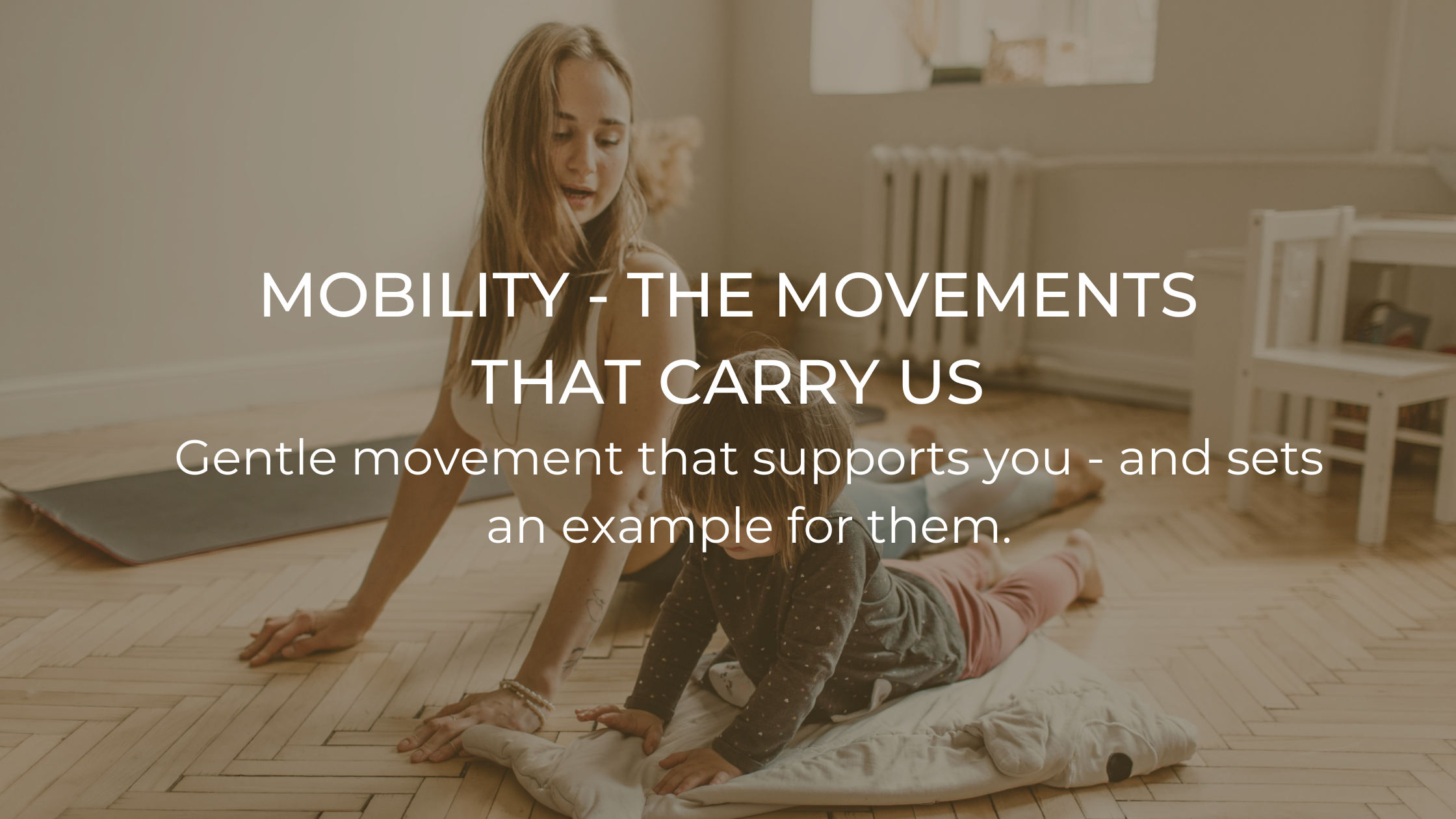
Movement that supports you — and shows them how.
Micro‑movements — the stretches, breaths, and little resets — keep us grounded through the day. But mobility, those bigger intentional ways we move, is what helps us feel stronger, clearer, and more resilient over time. A walk, a yoga flow, a swim, or even dancing in your kitchen — it’s not about “exercise,” it’s about giving your body freedom to move with ease. The small and the big together create a rhythm that supports us daily.
Why Mobility Matters
Mobility touches so many parts of our health:
It keeps blood flowing and energy steady.
It supports muscles and joints, so everyday tasks feel easier.
It clears the mind, reduces stress, and sharpens focus.
It builds resilience so we can adapt to life’s demands.
And it lifts mood — those endorphins remind you that you’ve done something good for yourself, leaving you lighter and more positive.
Mobility Can Be Simple
It doesn’t need to be complicated or time‑consuming. Start small and build it into your routine:
Lay out a foam roller or mat the night before so it’s ready.
Begin with 5 minutes in the morning. If it feels good, grow to 10, 15, or 20.
Roll tight muscles or stretch gently to release tension.
Rotate focus: upper body one day, lower the next, then whole‑body stretches.
Warm up stiff muscles with simple moves — reaching for your toes while seated, keeping your core engaged, or light mobility stretches.
Try adding little moves around daily habits: 5 sit‑ups after brushing your teeth. Twice a day makes 10 without effort. By keeping the count small, it feels achievable, and you’re less likely to miss a day. That consistency makes it sustainable, guilt‑free, and gradually builds into a habit that can grow when you’re ready.
Do them with intention. Focus on each movement and see it as your me time — a way to show care for yourself.
And remember, these little movements can also serve as an example for our kids. When they see us stretching or rolling on the mat, it shows them that looking after their bodies can be simple, fun, and part of everyday life.
Examples of Gentle Mobility
Mobility can be as simple as:
Rotating your head slowly to release neck tension.
Opening your hips with gentle stretches.
Stretching your back to ease stiffness.
Gentle strengthening for pelvic floor and lower back — bridges, bird‑dogs, or supported extensions that build stability while easing tightness.
These light movements don’t need equipment, and they remind your body what freedom of movement feels like.
Examples of Broader Mobility Practices
Mobility can look different for everyone:
A brisk walk that clears your head.
Yoga flows that open tight hips and shoulders.
Swimming or cycling for endurance.
Strength training for stability and confidence.
Dancing for joy and release.
Barriers & Gentle Reframes
We often hold back because of time, motivation, or perfectionism. But mobility doesn’t have to be long or intense.
Five minutes count.
Consistency matters more than performance.
Choose what feels good, not what you “should” do.
Mobility isn’t about doing it perfectly. It’s about weaving movement into your life in ways that feel good, both small and big. When we combine micro‑movements with bigger mobility practices, we create a rhythm that supports health, energy, and presence — and leaves us with that endorphin glow that reminds us we’ve done something good for ourselves.
💬 What kind of mobility feels good for you right now?
I share more gentle wellness content over on Substack — join me there → Read here
🎄 Festive Eating Without Fear
One joyful meal won’t undo your progress - here’s how to celebrate with calm and confidence.
The holidays arrive with sparkle and warmth - tables full, laughter rising, traditions unfolding. Yet for many of us, there’s also that quiet worry: will one joyful meal undo all the progress I’ve made?
You step on the scale after Christmas dinner and see the numbers climb. Fear whispers: “I’ve ruined it.” But here’s the truth - what you’re seeing is mostly water, not fat. Extra carbs, salty festive dishes, and celebratory drinks simply shift fluid in the body. It’s temporary.
Real fat gain takes sustained overeating - around 7,000 extra calories beyond your needs to add just 1 kg of fat. That’s several days of eating double your usual intake. One meal cannot erase your hard work.
🌟 Choose Presence, Not Guilt
Start the day with a nourishing breakfast - maybe eggs and greens, or yoghurt with fruit - something that steadies your energy so you arrive at the table calm, not ravenous.
Keep lunch simple and balanced - soup with wholegrain bread, or a bean‑filled salad - to keep blood sugar steady and appetite in check. Skipping meals to “save calories” only backfires: hunger builds, cravings intensify, and overeating becomes more likely.
🎶 Imagine This
The table is cleared, laughter still echoing from the meal. You sip some water, feeling lighter, clearer, more at ease. Instead of rushing to “burn off” what you’ve eaten, the evening unfolds into joy.
A short walk outside, crisp air on your face, chatting with family. Back inside, music plays, and suddenly you’re dancing in the living room, shoes kicked off, everyone smiling. Later, a silly game begins - cards, charades, or something made up on the spot - and the room fills with laughter again.
These moments aren’t about calories or control. They’re about connection. Hydration, light activity, and shared fun become part of the celebration itself - not punishment, but presence.
🌱 Gentle Takeaways
Don’t panic at the scale jump - it’s usually water and food volume, not fat.
Drink plenty of water - it helps your body settle after festive foods and keeps energy steady.
Keep your normal meals - breakfast and lunch calm your appetite and prevent overeating later.
Build a balanced plate - half veggies, a quarter protein, a quarter carbs, plus a little healthy fat.
Move with joy - walking, dancing, or family games aid digestion and lift mood.
Eat slowly and savour - give yourself time to taste, chat, and notice fullness.
Balance festive flavours - enjoy the rich dishes you love, but pair them with lighter sides to feel good afterwards.
Return to rhythm - after the feast, resume your usual meals and habits. Your body naturally resets.
Keep the focus on what truly matters - family, relationships, happiness, and cherishing the moment.
Restriction steals joy. Guilt drains it. Celebration restores it.
Festive eating isn’t about undoing progress - it’s about weaving joy into the habits we’ve already built. Balance doesn’t mean restriction; it means making space for both nourishment and celebration.
This season, may we permit ourselves to enjoy the table, the company, and the moment 🌸
“If this resonated, come join me on Substack - that’s where I share more gentle, seasonal reminders straight to your inbox.
Beginning This Journal
It all begins with an idea.
This journal isn’t about perfection - it’s a space to notice, reflect, and explore.
Hello, I’m Laura. I’m a nutrition student and someone curious about how everyday choices shape our wellbeing. Over time, I’ve found myself drawn to writing as a way to notice patterns, reflect on lessons, and share what I learn along the way.
This journal is not about perfection or prescriptive advice. It’s a space for exploration - from food relationships to energy balance, blood glucose, PMS, digestion, and the patterns that connect body and mind. Some posts may be personal reflections, others may be insights from study or practice. I hope that each entry feels approachable and sparks thought, whether you’re here for curiosity, support, or simply companionship in the journey.
I’ll be sharing reflections at an easy pace, sharing what I learn and notice as I go. If this resonates, you’re warmly welcome to follow along, reflect, and explore with me.
This reflection also appears on my Substack - join me there if you’d like to receive posts by email.
Finding Balance Beyond “Less is Better”
It all begins with an idea.
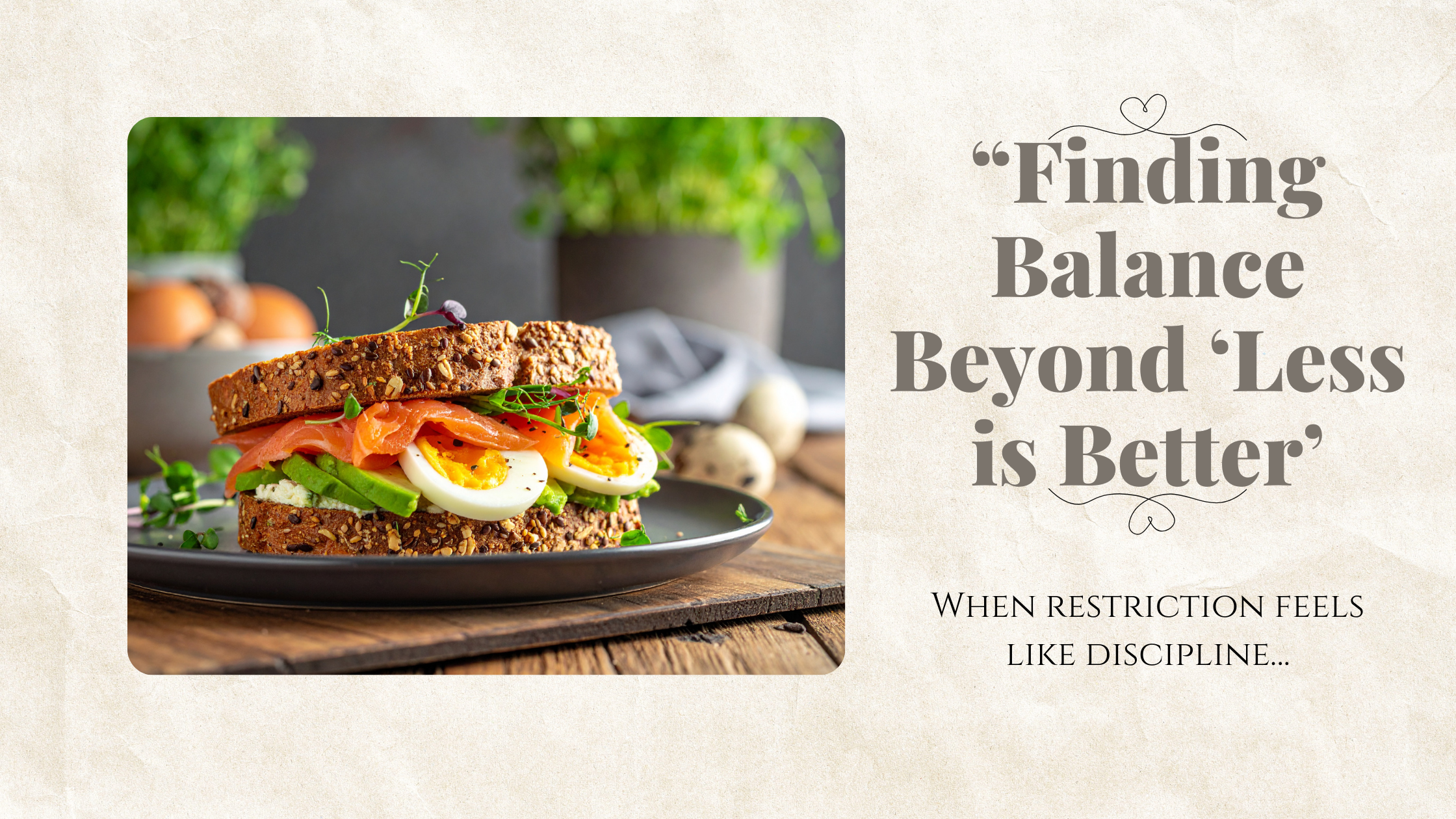
It’s not about less - it’s about enough.
For a while, I thought I was making the right choices - smaller portions, lower‑calorie foods, skipping carbs here and there. Some I avoided because I never really enjoyed them, but others I cut out almost unconsciously, maybe as a way of control.
Looking back, I can see the patterns: reaching for a cookie to quiet hunger, or a handful of sweets to get me through the afternoon. I believed those choices were lighter, but in reality, they carried more calories than I realised, with little to no nutrients. They gave me a quick sugar high, followed by a heavy slump later in the day. Meanwhile, a quick wholegrain sandwich, grabbed on the run, with protein and fats to carry me through, could have offered similar calories, but with fibre and steady energy that truly nourished me.
Over time, the signs became harder to ignore: constant tiredness, frequent colds, skin looking dull, and energy that never seemed to last. What I thought was discipline was really my body’s way of signalling that something wasn’t right.
Through study and reflection, I began to see the difference: restriction wasn’t helping me feel healthier; it was holding me back. Balance is what truly sustains wellbeing. Each nutrient has a role, each choice a purpose. It’s not about less - it’s about enough.
Learning to eat with intention instead of reduction has been one of my biggest lessons. Balance isn’t about cutting out, it’s about tuning in - and choosing nourishment over control is a shift that continues to unfold.
✨ What I’ve come to realise is that the smallest choices - the ones that feel ordinary or rushed- often can make the biggest difference to how we feel. Nourishment isn’t about grand gestures; it’s about the quiet, everyday balance that carries us through.
Thanks for reading - I’d love to know what balance looks like for you right now. 🌱
This reflection also appears on my Substack — join me there if you’d like to receive posts by email.